Archives for category: Personal Growth

While preparing to co-facilitate a men’s weekend, I came across this quote from James Thurber. It applies to all of us regardless of gender but is particularly apt for us men.

“All men should strive to learn before they die, what they are running from, and to, and why.”

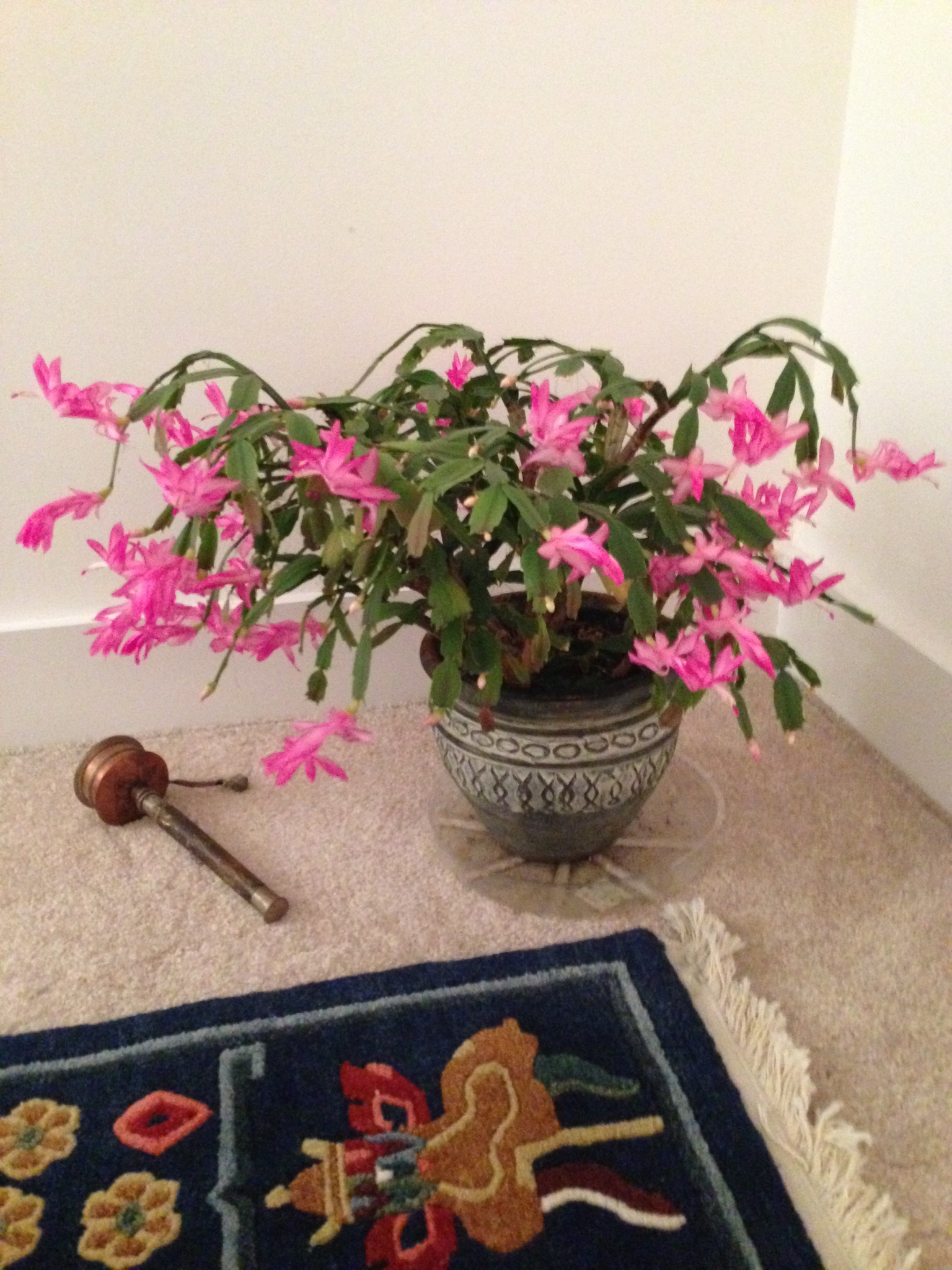
IMG_5225

The green tendrils are extended, waiting. Months go by. Hope fades with little sign of life. Is it but a plastic imitation?

December is the cold season of waiting. Is it our losses that populate our darkness – a loved one? our health? a job? Is it the passage of time and our aging we grieve, as we await earth’s turning and the arrival of new light?

Is our inner landscape really desert dry, or is the impatience of waiting the signature of a gestation that one day, unannounced, delivers a cascade of sunrise pink blooms and a rebirth of possibilities?

In a reading from Pocketful of Miracles Joan Borysenko reminds us that grace is a gift.  It is independent of our good works or our failings.  She goes on to cite the words of a Hindu master: the winds of grace are blowing all the time – we just need to raise our sails.

Graceful living combines awareness, intention and action. Awareness is being mindful of what is going on around us and what our bodies are telling us.  Anyone who has sailed knows the importance of being attentive to the presence, force and direction of the wind.

Intention is setting the destination.  It may be to complete a project due at the end of the week.  It may be to embark on a journey of many months or even the rest of our life.

However, unless we take action, unless we raise our sails, we will not harness the winds of grace. Stuck in our doldrums we will miss the gifts the universe offers us.

What does it mean for you to raise your sails today?

In her book, Wrestling with Our Inner Angels, Nancy Kehoe highlights lessons from her vocation as a nun and clinical psychologist working with the mentally ill.  She cites one patient who described his Zen practice as a way to stay centered and his music as a way to stay connected. Staying centered and staying connected are simple but profound pursuits at the core of spirituality and leadership.

Staying centered is at the heart of most religious traditions and spiritual practices.  It involves being present in the moment, developing awareness of self, being mindful of others and the world around us and opening ourselves to the sacred, however we understand it. Staying centered in leadership requires aligning performance with key personal and organizational purposes and values and flexing with inevitable changes in the environment.

Staying connected is a spiritual practice of nurturing our essential relationships with ourselves, partners, families, friends and the animals we tend. Staying connected as a leader involves holding true to the mission, cultivating relationships with customers, team members and other stakeholders and anticipating both threats and opportunities.

Reflecting on staying centered and connected to self and all that surrounds us, I am reminded of a line from As You Like It: “these are counsellors that feelingly persuade me what I am.”

What do you fear?  Maybe the best way to deal with it is to lean into it.

It was minus ten degrees this past week – not unusual for winter in New Hampshire. Those of us accustomed to this climate know that we must be aware of two consequences: frostbite and hypothermia.

Exposed flesh freezes quickly when the temperature dips below zero (F). The likelihood increases dramatically when you add wind to the equation.  Freezing flesh kills it, leaving dead or damaged tissue when it is re-warmed.

If the body itself cools down below a certain point, critical functions are at risk and begin to shut down.  This is called hypothermia.  Without warming death is inevitable.

A survival technique I learned in Outward Bound years ago requires you to burrow in the snow to stay warm.  It is counterintuitive, a fact that has a great lesson to teach us about life and our fears.  One day I built an igloo out of blocks of snow and ice and slept in it that night.  The temperature outside dropped to -15 (F).  The temperature inside the igloo was 15 degrees.  While I was dressed warmly for my experiment, those 30 degrees could be the difference between life and death for someone less prepared.

I dare say few of us will try this stunt.  On the other hand, every one of us faces harsh realities and the consequences of our fears.  The lesson here may be: rather than let our fears freeze us, we should lean into them in order to reduce their hold on us.

Each day we light candles and oil lamps in our home. It is not because we don’t use electricity to see at night. Nor do we avoid the technology of lasers or LEDs. After all, solar panels power our house.

Rather, the flame’s flicker signals our deeper connections of the spirit. The candles attend our daily meditations. They bless our meals. They stab the darkness with gentle spikes that give us strength to deflate our fears. They accompany our celebrations. We light them to remember loved ones, special seasons and rites of passage.

The greatest gift in lighting candles may be to remind ourselves of our purpose in life.  When stripped of all pretense and presumption, that purpose may be nothing more and nothing less than offering the light and warmth of our love to all around us.  May that flame burn brightly today and all seasons of our life.

A friend who is living with an invasive and aggressive cancer posted this poem on his Caring Bridge page.  It is not an easy thought to embrace, and I wonder about his ruminations on it in the middle of his nights.

Unsettling as it is to our conventional ways of answering our doorbell, it is an invitation to each of us to reflect on a deeper definition of our soul’s hospitality.

THE GUEST HOUSE – Jelaluddin Rumi (translation by Coleman Barks)

This being human is a guest house. Every morning a new arrival. A joy, a depression, a meanness, some momentary awareness comes as an unexpected visitor.

Welcome and entertain them all! Even if they are a crowd of sorrows, who violently sweep your house empty of its furniture, still, treat each guest honorably. He may be clearing you out for some new delight.

The dark thought, the shame, the malice, meet them at the door laughing and invite them in. Be grateful for whatever comes, because each has been sent as a guide from beyond.

The presidential campaigns employ a powerful strategy: define the opponent before he can define himself.  Better to be seen on the offensive than defensive!

A twist on that dynamic raises a life lesson I encounter in coaching. Too many of us accept someone else’s definition of who we are and then spend most of our energy on defense. Should we be surprised that our lives are out of alignment?

Of course, we have been defined by others since our childhood beginning with our parents and siblings. Soon, it is our teachers and peers and advertisers telling us who we are and who we should be.  Our acceptance of these messages becomes our story. Repeated often enough, we accept the story as our destiny. It defines us.

Unfortunately, like the political campaigns these stories are often based on others pointing out our deficiencies – lack of looks, lack of smarts, lack of ability, lack of ambition. They tell us these things out of anger in the moment or to put us down in order to build themselves up. Too often we accept the messages. We give the power to others to define us.

Creating our own narrative is the most sacred task we have been in given in life.  The key to writing a new history begins with a decision to leave the “lacks” in the past, acknowledge our innate power and step fully into it.

We can begin by answering these questions.  What do I care most deeply about? What are the things I do well? What is the story I want to create for myself and live now?

I am a problem solver and a doer, and when it comes to seeing people wrestling with life’s challenges I tend to want to “fix it.”  In part it may be a guy thing, or it may be related to my temperament.

As a coach and a caregiver, however, I have to check myself, because this tendency does not serve me or my clients well.  It is more important for me to help them clarify their challenge(s) and their options and then hold the space for them to choose their course.

The same applies to our more intimate relationships.  If you are also a “fixer,” today’s meditation from Mark Nepo in The Book of Awakening is a good reminder to us.

“Frequently, this reflex to solve, rescue, and fix removes us from the tenderness at hand.  For often, intimacy arises not from any attempt to take the pain away, but from living through together; not from a working out, but from a being with.  Trust and closeness deepen from holding and being held, both emotionally and physically. 

I’m learning, pain by pain and tension by tension, that after all my strategies fail, the strength of love waits in receiving and not negotiating; in accepting each other and not problem solving each other; in listening and affirming each other, not trying to change or fix those we love.”

The Boston marathon took place last week on one of the hottest days in its history.  Having run it in 2003, I have some appreciation for what it takes to qualify and to complete it.  More than a marathon, it is metaphor, which is why many people do it.

Emblazoned across the 2003 poster that hangs in our workout room is a phrase that I see every time I step onto the treadmill.  Everything you ever needed to know about yourself you can learn in 26.2 miles.

Some of the lessons to be learned by extending oneself physically include: setting personal goals for the event; discovering the training discipline that works for you to meet those goals; persevering through the days when you don’t feel like it; listening to what your body is telling you; and stretching your body to do more than it ever has before.  At some point you realize that the physical challenges are really just the tools for training your mind to be positive in attitude and consistent in effort.

Each of us has much to learn from our own versions of 26.2 miles.  What are your metaphors?  Starting your own business?  Releasing a fear that has defined you most of your life?  Committing to a relationship?  Raising children?  Caring for animals?  Speaking from the podium or performing on stage?  And what are the small steps you are taking each day to build your attitude and effort for success?

Whatever your marathon, I encourage you to embrace it whole heartedly, and I salute you for going for it!  Stretching your comfort zone in service to your purpose and passion can provide everything you ever needed to know about yourself.