Archives for category: Relationships

IMG_7745

The aggression of our species spans a continuum of violence, including abuse by self and others, deceit, character assassination, environmental degradation, murders, suicide bombings and war. Those who would be peace makers must wonder where to begin.

A start is to recognize the ironies. Love is the aspiration at the heart of most world religions. It is the opposite of the fear that drives our aggression. And yet, despite the tenet of love, with words and deeds extremists kill those whose beliefs are different. A third paradox is that the warrior energy that drives us to destroy is the same power that motivates us to protect. It all depends on how and where we direct it.

Cultivating the peaceful warrior begins within. In The Tibetan Book of Living and Dying, Sogyal Rinpoche introduces meditation practice with a formula. Return to the state of abiding calm through quieting the mind, even for a few minutes each day. Release the fear of loss of attachments, those relationships, material things and status which we take as our identity. Relax into the true nature of mind that gives us rest. The formula seems simple. The “doing” is more difficult.

While it stretches belief to think our actions can change hate-filled hearts around the globe, we can begin where we are. Peace within is the first step in transforming aggression and healing our divisions. The splash of our effort will send ripples across the ponds of our influence. How do we show up with those we love? With our neighbors? What are the messages we deliver to them and to those on our social media?

Love needs us all and calls us to be our better selves. What is one step you can take today to expand your peace making?

IMG_7745

Ever wonder why someone in particular is in your life? That person may be someone who is dear or obnoxious, affirming or unnerving, compatible or divergent. What questions does s/he raise for you?

Those of us who belong to families or interact with children or work with our heads or our hands or teach or buy groceries or volunteer or show up as friends — in short, all of us – define ourselves by the way we respond to the questions posed by others. In fact, where would we be without the queries proffered by life and those with whom we share it?

Raising questions and exploring answers to those questions is critical to shaping our lives and the meaning that accompanies them. We need each other for that exchange. Those of us in the “helping” professions are taught to frame questions in such a way that in answering clients recognize and embrace their own truths.

Even in the midst of our perplexities or discouragement, whether in the asking or in the answering, questions are intermediaries of grace that can lead us into deeper levels of appreciation, insight, wonder, meaning and joy. Denise Levertov brings this home to us in her poem, A Gift.

Just when you seem to yourself

nothing but a flimsy web

of questions, you are given

the questions of others to hold

in the emptiness of your hands,

songbird eggs that can still hatch

if you keep them warm,

butterflies opening and closing themselves

in your cupped palms, trusting you not to injure

their scintillant fur, their dust.

You are given the questions of others

as if they were answers

to all you ask. Yes, perhaps

this gift is your answer.

IMG_7745

A passage I recently read prompted this post. It expresses gratitude for friendship and the many ways that people walk with us through life.

Friends accompany us along differing paths and in differing depths. They have shared times that have been significant to us – difficult, perplexing, reflective, joyful and just plain fun. In that sense they represent chapters in our living history. They bring out the best in us and give us permission to be our “real” selves, even when it isn’t our best. They bear witness to who we are and what we are about.

I explored this theme in The Company of Friends, a post from this blog a year ago. Daphne Rose Kingma’s passage below brought it all back. Blessed are we who can acknowledge the gifts of our friends’ companionship.

Thank you for the circumstances that brought us together and have bound us into the sacred bundle of life. Thank you also for the gifts of our friendship: for knowledge that comforts, for words that encourage, for insight that blesses, for all the experiences shared, for the sweet bliss of deeply knowing each other in so many ways; for history and a hope of the future, for conversation and laughter, for silence, for bearing each other’s witness truly, for holding each other safe in our hearts with great love and tenderness.

Today is a good time to pause and give thanks for the friends in your world – maybe even contact them to tell them how much they mean to you.

IMG_7745

I have returned home from a week in Colorado filled with friends, clients and family. The blessing of these relationships brought to mind a line from Carly Simon’s song –  these are the good old days.

How easy it is to spend time looking back to what our life used to be or anticipating what might lie ahead. Given my age, I confess to a certain amount of dread for what the coming years will bring.

This focus has been fueled in part by Atul Gawande’s book Being Mortal which I have read in preparation for an upcoming discussion with friends from high school days. Written by a doctor, it is a frank account of the aging process and death and ways we and our culture deal with both.

In Still Here, a book by Ram Dass completed after he experienced a debilitating stroke, I found a gentle reminder that has bolstered my spirits and resolve to be here now.

As the Tibetan teaching instructs, we learn not to “invite” the future into our thoughts before its time, or to cause ourselves unnecessary discomfort, for just as the past traps us in memories, the future traps us in anticipation.

 In the popular idiom of days gone Carly Simon’s classic sums it up well.

We can never know about the days to come

But we think about them anyway

And I wonder if I’m really with you now

Or just chasin’ after some finer day

 Anticipation, anticipation is makin’ me late, is keepin’ me waitin’…

And tomorrow we might not be together

I’m no prophet and I don’t know nature’s ways

So I’ll try and see into your eyes right now

And stay right here

‘cause these are the good old days.


IMG_7745

In a note last week to her parents whom we know well a young woman recounted a conversation they had almost thirty years ago. It ended with their mutual conclusion that it was time for her to leave home. It was not an easy decision for any of them. She was completing eighth grade.

The prospect of her absence from her family as she grew into adulthood loomed large, but what prevailed over convention was a compelling gravitational pull. In was, in the words of Joseph Campbell, to follow her bliss, and for this young girl her bliss was dance.

Her path took her many places. She danced in New York and venues in Europe, Russia and South America. She created her own company and along the way discovered a love of teaching.

The occasion for her note of gratitude was the culminating performance for her Master of Fine Arts degree. She choreographed and danced in a 30-minute piece of her creation involving twelve other dancers. She chose the music and integrated graphics created by art students who attended one of her rehearsals. In the audience her parents beamed along with siblings, her husband and her daughter.

Words from Kahlil Gibran came to mind.

Your children are not your children. They are the sons and daughters of Life’s longing for itself…

You are the bows from which your children as living arrows are sent forth. The archer sees the mark upon the path of the infinite, and He bends you with His might that His arrows may go swift and far.

Let your bending in the archer’s hand be for gladness; for even as He loves the arrow that flies, so He loves also the bow that is stable.


Ice Harvest 2016 (1) IMG_0386

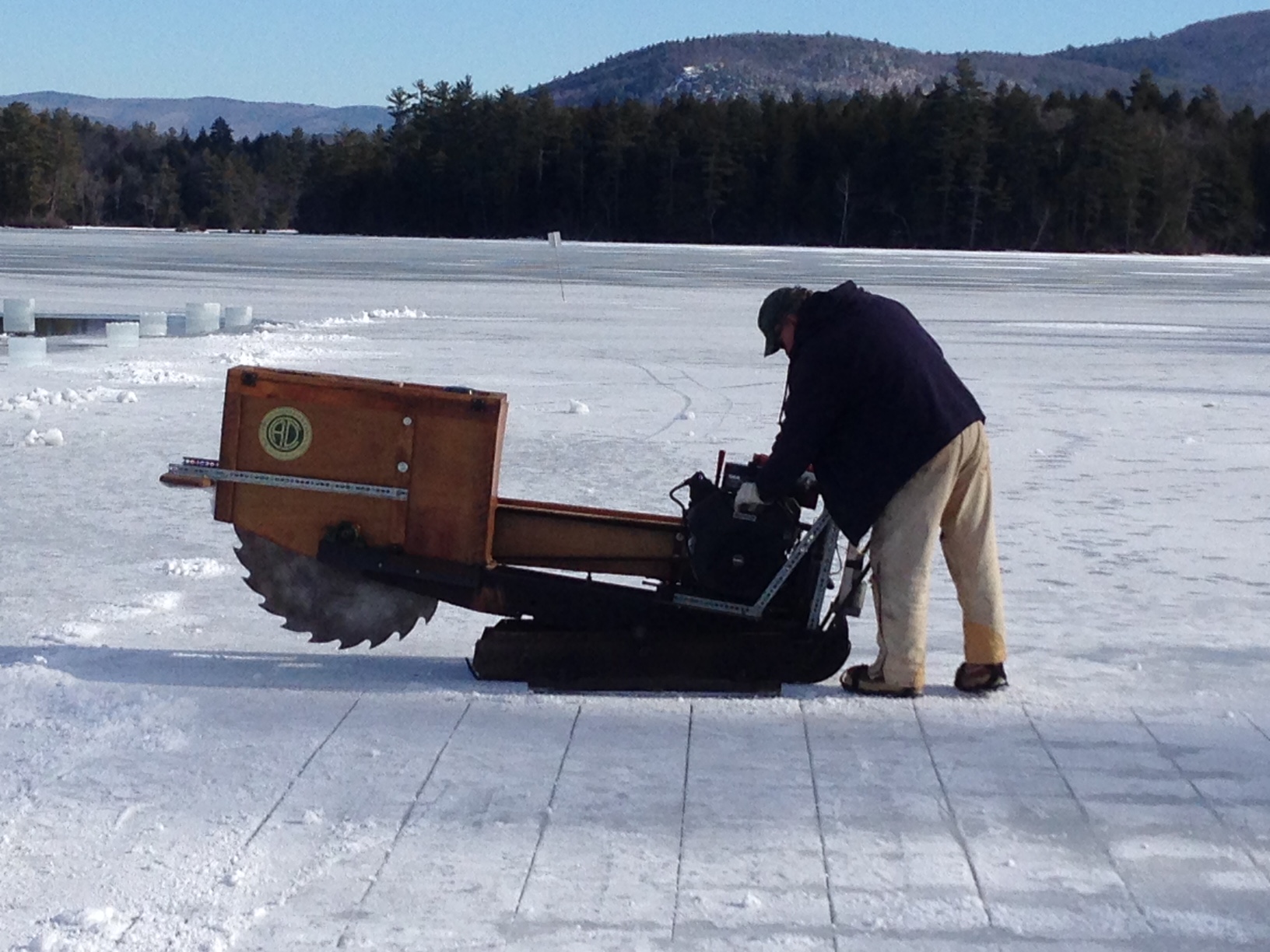
Last week I joined some friends in harvesting ice for their refrigeration system. Much more than an annual ritual it is only one element in the composition of their chosen path of homesteading. Living off the grid, they have been creating a life of self-sufficiency that nurtures mind, body and spirit and leaves a minimal carbon footprint on the planet.

Cutting and retrieving 120 pound blocks of ice requires teamwork, and our friends are able to join with staff and volunteers of a local summer camp to share in the labor and harvest. A necessity before electric refrigeration began to replace the ice box, gathering hunks of frozen water has become an annual tradition of the Rockywold Deephaven Camps since the late 1800s. They continue to use the ice boxes of yesteryear for their refrigeration.

As this 2-minute video of this year’s operation reveals, today’s ice-collecting methods include some contemporary tools – e.g., gas-powered saws, winches and trucks. Sparingly, our friends use some of those devices as well for cutting and gathering firewood and transporting heavy loads, although they use manual block and tackle pulley systems to lift the ice blocks into place.

Covered in a foot of sawdust to insulate them from the summer heat, the blocks are stored in an ice house and will last up to 12 months. Harvesting ice is a throw-back for sure to days when folks tapped every resource available for survival in northern climes and banded together to help each other make it through the year.

In today’s world of short-term grab for greed and convenience, I celebrate occasions that highlight both the ingenuity and determination of self-sufficiency and the mutual interdependence of community.

Ice Harvest 2016 (1) IMG_0377Ice Harvest 2016 (3) IMG_0376Ice Harvest 2016 (4) IMG_0384Ice House 2016 IMG_0392


IMG_7745

At our monthly men’s group meeting this week one of our members remarked how quickly time is passing. Now in his sandwich years his life overflows with the joys and duties of spouse, father and son. Like many he struggles to balance all of this with grace, while at the same time responding to the nagging tug that wonders if there is something more to satisfy his soul’s longing.

More than twenty years his senior, I smiled to myself, having traversed much of the ground that lies before him – not that his journey will be similar to mine, but that he will continue to formulate his answers to the questions that life brings to each of us. For me the focus is the closing window of time remaining and the fear that it will slip away unattended.

I continue to ask myself two questions. Am I doing my soul’s work? Am I doing it with the people who love, challenge and encourage me? My joy and blessing is that I am able to answer YES to both questions.

Do you answer YES? If not, an opportunity invites you to take the first step now to move toward your YES.

As my friend spoke, the refrain of a favorite song visited me with its lyrical counsel about time, fear and friendship. It is Sandy Denny’s signature song also covered by Judy Collins.

And I am not alone, while my love is near me. 

I know it will be so until it’s time to go.

So come the storms of winter and then the birds in spring again

I have no fear of time.

For who know where time goes?

Who knows where the time goes?


IMG_7745

From the earliest days of language humans have told stories about their experiences and ascribed meaning to those incidents. Listeners believed the stories to be true or changed the account. At some point the stories began to incorporate events that had not yet happened or were not tangible.

According to Yuval Noah Harari in his Ted Talk What explains the rise of humans? our ability to construct stories and act upon them as if they were true distinguishes us as a species. What sets us apart is our ability to imagine and to act collectively as if it were reality.

Our stories constrain us and they free us. How many of us carry a story from our past that limits us personally? One of the gifts of therapy and coaching is to help people create new storylines that emphasize strengths rather than deficiencies.

How many of us embrace accounts about our race, religion, nationality or way of life? These stories unite us in common purpose. They also divide us when we view the “other” as an enemy to be eliminated.

If individuals turn to therapists to create new stories, how do we do so as a species? Perhaps, as verses from John Lennon’s iconic song remind us, we begin by tapping our imaginations in order to create a new narrative.

…Imagine there’s no countries
It isn’t hard to do
Nothing to kill or die for
And no religion too
Imagine all the people
Living life in peace…

Imagine no possessions
I wonder if you can
No need for greed or hunger
A brotherhood of man
Imagine all the people
Sharing all the world…

You may say I’m a dreamer
But I’m not the only one
I hope someday you’ll join us
And the world will live as one.


IMG_7745

Prompted by the strident and polarizing rhetoric of political campaigns, conversation with friends this past week surfaced the lack of comity in our nation’s social and political discourse.

With its root in the Latin word for friendly comity means the cordial recognition of the other person and/or the other person’s position. In international relations comity acknowledges the sovereignty of another country and its representatives. It is also associated with decorum, the ground rules for debating differing positions and points of view.

Comity is under siege today. One symptom is the rebellion against compromise, which for some means meeting in the middle to solve problems; to others it connotes capitulation. Political correctness is another challenge to comity. Embraced by some to foster inclusiveness, it is vilified by others who feel muzzled by a progressive agenda.

Each year at this season the questions surrounding compromise and political correctness surface in another way. Why can’t all of us just greet each other with Merry Christmas? After all, the prevalent religion in this country is Christianity.

As with our politics our response to that question relates to our world view. Do we just need to get back to the ways that served us well in the past when life was simpler? Or, do we need to learn how to integrate the inevitable changes coming our way, including the influx of a growing number of people from diverse cultures, the requirements of justice at home and abroad and the environmental threats to the sustainability of our land, water and food?

Resurrecting comity may help us bridge our divides. After all, the baby whose birth Christians celebrate called us to live lives of love and reconciliation. The way we treat each other is the medium of the message.

IMG_7745

The younger man sat across from me, and we explored a dilemma he’d brought to share. Words and feelings flowed back and forth, gradually filling the space between us like gentle waves of an incoming tide.

We belong to a group that has been meeting monthly to support and challenge each other with what it means to live our lives as men. Our ages range from late 30s to early 70s. As sons, spouses, fathers and some of us grandfathers, we are eager to learn from each other how we define ourselves at our various stages of life, how we nurture our most important relationships and how we manage our livelihoods.

Conscious or not in the moment, each of us knows we bring our own father with us into the room. Not surprisingly our father-son relationships run the gamut, informing each of us in the ways we show up in life.

Robert Hayden writes of one such relationship, revealing that the “offices” of love can sometimes be hidden in the raw reality of routine, or under-appreciated in light of conflicts. For those of us in cold climes who heat by wood, the image is particularly poignant.

Sundays too my father got up early and put his clothes on in the blueblack cold, then with cracked hands that ached from labor in the weekday weather made banked fires blaze. No one ever thanked him.

 I’d wake and hear the cold splintering, breaking. When the rooms were warm, he’d call, and slowly I would rise and dress, fearing the chronic angers of that house, speaking indifferently to him, who had driven out the cold and polished my good shoes as well.

 What did I know, what did I know of love’s austere and lonely offices?