Archives for category: Spirituality

IMG_7745

Sticks and stones will break my bones but names will never hurt me. Taught by parents to an earlier generation of children as a defense against the cruel words of taunting peers, the verse betrays the reality. Name calling does hurt; think of the number of teen suicides in response to bullying.

The power of words is particularly evident in our cultural, religious and political conflicts. Wherever each of us stands on the spectrum of right to left, we know what phrases to expect from the other side and which are most effective for us to use from our own arsenal. Like an ice berg many of these words are code for a much larger load of assumptions and beliefs below the surface.

Take your own pulse for a moment. What thoughts or feelings come up with the following words? Flag. Second Amendment. Amnesty. Compromise. Forgiveness. #BlackLivesMatter. Marriage. Heritage. Amazing grace…

Our words help us declare who we are and what we stand for, our integrity. They can be weapons we use to defend ourselves or attack others. They also are tools for understanding, bridge building and reconciliation. The choice is ours – daily.

Words can inspire as in Rachel Remen’s contribution to Prayers for a Thousand Years, a compilation of hopeful expressions for the new millennium.

May we find each other in the silence between the words.

May we heal the loneliness of our expertise with the wisdom of our service.

May we honor in ourselves and all others the deep and simple impulse to live, to find sacred space and open land.

May we remember that the yearning to be holy is a part of everyone and the only hope for the next thousand years.

Rainbow (2) IMG_1440

IMG_7745

The murders in Charleston last week coupled with the carnage committed elsewhere in this country and around the globe, are repugnant as killings and as instruments of racism. They are so aversive to my values and beliefs they leave me grappling with how to respond. I offer three thoughts.

The first is to share my unrest and invite your perspectives. How are you confronting these realities? What are your reflections, suggestions and actions?

Next, I seek to understand. If my head holds reasons why, my heart will more likely tap its courage for action. I believe that fear is the opposite of love. In order to alleviate our fears, most of us tend to affiliate with the familiar – faces, places, values and beliefs. Bolstered by our cohorts WE tend to define THEY as different and potentially threatening; we put THEM in the boxes of OTHER, where it is easier for us to control, manipulate, win, vilify or destroy. Our current politics and social media provide a mirror.

Another lens for understanding is our history and the values of those who settled this continent. Vestiges of their religious views, white patriarchy and slavery-based commerce persist today. A still larger lens would be to view our values and actions in relation to the survival of the planet.

Lastly, I am one individual with limited time. How do these events refocus me on my soul’s journey? Buddhism teaches that one root of suffering is aversion. Luke reminds Christians that the kingdom of God is a destination within each of us (17:21). Exploring those things that are most aversive may help my heart discover a new depth of love within and the courage to shine its brightness into the darkness without.

Bob MacArthur

A dose of anxiety can help us achieve our peak performance, but too much stress can immobilize us and endanger our health. Think of toxic conditions at work, conflicts in relationships, acting to please others and over-committing ourselves. How do we find the balance?

Our body has an amazing capacity to regulate itself in seeking balance, homeostasis. Think of how it maintains its core temperature. When cold, it shivers to generate warmth. When hot, it sweats to dissipate heat. These are involuntary responses. If we pay attention, we can use them as barometers of balance and health.

For example, when our brain senses we are in peril, it floods our body with adrenaline, cortisol and other hormones that mobilize us to fight or flee. We can feel our heart pound and our pulse race in preparation. However, if the real or perceived danger is sustained and our emergency response chemicals persist in our body, they can damage our heart and weaken our immune system. At some point symptoms of dis-ease will surface in discomfort, pain or lumps.

We compose our lives with the decisions we make. Becoming aware of our body’s signals to us is the first choice in regaining equilibrium. Other decisions include seeking help in resolving intractable conflicts and declining when asked to add one more commitment to an over-extended schedule. Choosing to make time for self-care is essential – walk, read, ride, practice yoga, meditate.

There is a Buddhist invocation that reminds us of the goal to seek balance in living. I have adopted a version of it as an aspiration for composing my life. It is simple but full of truths to ponder.

May I dwell in the great equanimity free from attachment, aversion, aggression and prejudice.

IMG_0178 - Copy

This week our family celebrates Peggy’s birthday. With winter lingering the arrival of her special flower is delayed, but its significance is seldom absent whatever the month.

Daffodils have accompanied our life together, the gift of a Limeliters’ song some fifty years ago.

I do not have a mansion. I haven’t any land. Not one paper dollar to crinkle in my hand. But I can show you morning on a thousand hills, kiss you and give you seven daffodils.

I do not have a fortune to buy you pretty things, but I can give you moonbeams for necklaces and rings. And I can show you morning on a thousand hills…

Seven golden daffodils shining in the sun, light our way to evening when the day is done. And I can give you music and a crust of bread, a pillow of piney boughs to rest your head.

With the color of sunlight and its cyclical profusion this simple flower reminds us of earth’s bounty and the life-giving riches that sustain body and soul.

The romantic dreams and meager means of youth have seasoned. We saved a few paper dollars and with the generosity of many acquired some land. The home built by friends and our sons is a mansion to us. Each morning the view encompasses several hills. Music and singing join our three generations. Peggy’s home baked bread nourishes us well beyond the crust of necessity. Now a perch for resting birds, the piney boughs wave above their hillside neighbors.

Most amazing, perhaps, is the bouquet pictured above. It greeted us as we arrived on the land the spring we broke ground. There were no other flowers in sight. Their origin remains a blessed mystery, as does the fortune we celebrate this April birthday.

IMG_7745

In life and in leadership having a vision is a keystone to success. A vision is an imaginary destination. The fruit of our creativity and our sense of possibility, a vision taps our longing for a sounder self and a better world. It inspires our attitude and guides and sustains our effort.

At some point in his life my father seized upon a maxim that became his signature admonition to his family: Be always kind, be always true. I have adopted it.

For me this vision is an aspiration that grows from two roots. One is nurtured in the spiritual soil of love and loving kindness. The other springs from a core value of integrity, captured in the advice of Polonius to his son Laertes in Hamlet:

This above all: to thine own self be true, and it must follow, as the night the day, thou canst not then be false to any man.

Having a vision does not mean that one always achieves it. I am painfully aware of coming up short in fulfilling my own, as I am sure family and friends will attest. On the other hand, if we achieve our vision consistently such that we are not stretching, it may be that our vision is too small.

Our personal visions must be large enough to embrace those of others. The daily media bombardment of the abuse, violence and warfare we inflict upon each other and the primacy of deception in commerce, politics and foreign policy cries out for a vision of kindness and truth.

What is the vision that guides your life today or that of your organization? Does it spring from your truths, your gifts and your longings?

IMG_0168

For many of us being busy is a badge of honor. We spend much of our lives doing. We define ourselves by the roles that we perform.

For many decades I have done the same, identifying myself by the function I played – student, athlete, spouse, priest, parent, CEO, coach, grandpa. Life was a to-do list of activities, many of which were linked to what I was taught men were expected to do; as Sam Keen described in his book Fire in the Belly – protect, provide and procreate.

Sometimes I “did” well; at other times, not so well. The defining by “doing” in and of itself is done, whatever impact it may have had for good or ill.

Today, I am shifting my focus from defining myself by living to do, to doing in order to be. No doubt, it is in part a reality check as the days remaining in this life grow fewer. I am choosing more activities that cultivate awareness of the simple beauties and complex dynamics of our journey. Meditating, being physically active, working and walking outdoors, writing and playing music are ways for me to develop awareness and attend more to the energy of the moment.

How do you define yourself? Is it the sum total of your activity and the roles you play? Is it the impact your activity generates on those around you? Is it the container you hold for yourself or others to receive the grace of each moment? Perhaps it is all of the above, a harmony of doing and being. We can be grateful and accountable for the fact that it is ours to choose.

IMG_7745

How often each day do you cross a threshold? Probably many times, when you stop to think about it. Every door you pass through is a threshold from one space to another.

In the familiarity of our daily routines most of us don’t pause to think about it. Even when we close a door to achieve privacy or to contain a pet, stepping across sills doesn’t rise to our awareness. That is, until we come to a new one.

A threshold grabs our attention either when it beckons us with opportunity or threatens us with adversity. Leaving home for the first time called to many of us, as did committing to a relationship and pursuing our dream. Something compelled us to leave our zone of comfort to embark on a path of learning. For others of us the loss of a loved one or a job or the arrival of an invading disease impelled us into a new realm of discovery.

We know we are on the verge of a new possibility or threat when it involves risks and it demands our response. Our fear buzzer goes off. Adrenalin rushes to mobilize us, our signal that what we are facing is significant down to our core. We are at a defining moment on the brink of action. There is no turning back.

What is the threshold before you today – Defining yourself anew after ending a relationship? Committing to another day of sobriety? Taking that next step forward on a postponed path of heart? Whatever it is, embrace it with the knowledge that retreating may be safer in the moment but in the long run debilitating to the person you could be. And, remember, there is a company of sojourners who will support you over the brink and beyond.

IMG_7745

Do you remember the last time you were blindsided, when your words or actions or those of others caught you by surprise and threw you off-balance? Maybe it was at home, or maybe it was at work. Maybe it was in a special relationship or in your role as leader. Like a troll springing suddenly from under the bridge of our routines, it can happen anytime or any place, usually when we’re least expecting it.

It happened to me this week in a very mundane set of interactions. The details are less important than the fact that the episode triggered a response from my darker energies. The shadow followed me around most of the day…until a familiar question seeped into my funk: “What wants to happen here?”

It is an excellent coaching question that I first encountered several years ago in a workshop facilitated by Alan Seale. Through his teaching and coaching Alan encourages us to tap into the energy of our feelings in order to discover the potential that waits. Seeing and honoring the potential provides a powerful antithesis to the apparent negative block of the moment.

The question acknowledges at least two things. First, whatever we are doing or feeling isn’t working for us, probably because our ego has taken over. Second, maybe things are not working for us because there is a greater potential waiting to be released. Alan characterizes that greater potential as our soul and its mission, which may be 180 degrees from our current impasse.

The next time you’re stuck or surprised by your troll, it might help to ask yourself, “What wants to happen here?” Seeking the answers may open a whole new horizon.

IMG_0146

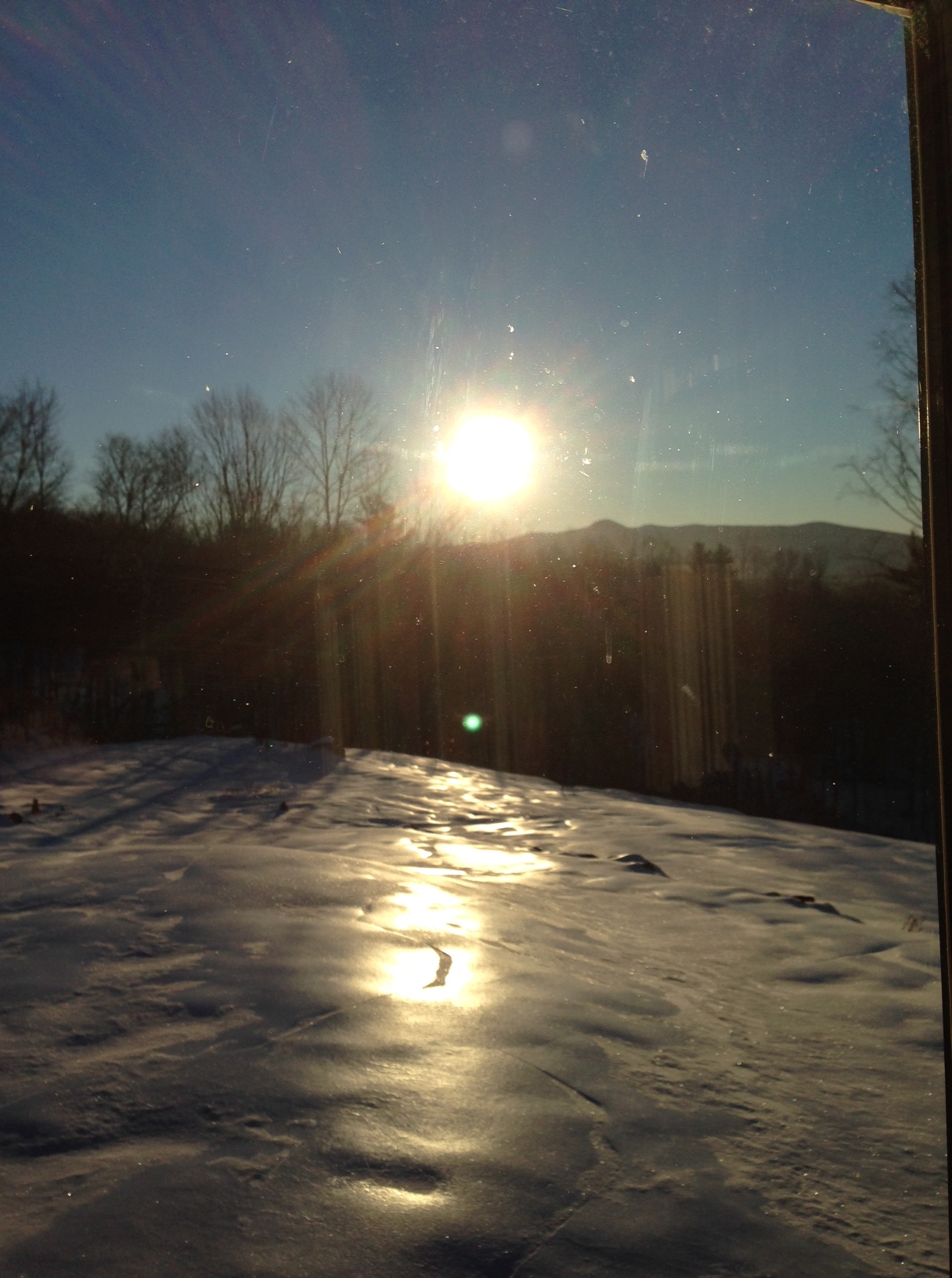
Outside on this mid-winter day the snow has an icy crust. One wonders what lies beneath? In his book, Seven Thousand Ways to Listen, Mark Nepo provides a reminder that may be helpful, especially to those of us going through a dark time.

In nature, we are quietly offered countless models of how to give ourselves over to what appears dark and hopeless, but which ultimately is an awakening beyond our imagining. All around us, everything small and buried surrenders to a process that none of the buried parts can see. We call this process seeding and this innate surrender allows everything edible and fragrant to break ground into a life of light that we call spring.

As a seed buried in earth can’t imagine itself as an orchid or hyacinth, neither can a heart packed with hurt or a mind filmed over with despair imagine itself loved or at peace. The courage of the seed is that, once cracking, it cracks all the way. To move through the dark into blossom is the work of the soul.

IMG_0144

Krista Tippett’s On Being post for the New Year featured the thoughts of two people whose writing is special to me and whose presence in person both calms the troubled spirit and troubles the complacent mind. Parker Palmer writes:

We look with uncertainty to the year ahead. But if we wrap our lives around life-giving questions — and live our way into their answers a bit more every day — the better world we want and need is more likely to come into being.”

He then frames the questions from the poetic insights of Anne Hillman:

We look with uncertainty beyond the old choices for clear-cut answers to a softer, more permeable aliveness which is every moment at the brink of death; for something new is being born in us if we but let it. We stand at a new doorway, awaiting that which comes… daring to be human creatures, vulnerable to the beauty of existence. Learning to love.

Palmer then asks himself and us five life-giving questions. Which do you choose to answer as you stand before the doorway that beckons this coming year?

How can I let go of my need for fixed answers in favor of aliveness?

What is my next challenge in daring to be human?

How can I open myself to the beauty of nature and human nature?

Who or what do I need to learn to love next? And next? And next?

What is the new creation that wants to be born in and through me?