IMG_7745

The week has brought another wave of terror. Amplified by instantaneous images and incomplete story lines, the stark reality that millions of people live with daily penetrates the walls that distance and privilege have built for the perceived safety of others.

The root of all hate is fear, the weapon of choice that perpetrators of every ilk employ, be they sick individuals or religious and political extremists.

Love waits at the other end of the continuum, the wellspring of personal worth and our most intimate relationships. Love is the progenitor of compassion and the golden rule that summons the best in our connections among communities, cultures, nations and our planet home.

May each of us pause to revisit the core of our being that is nurtured by love  and then in our own unique way raise our voice to speak our NO to fear and our YES to compassion.

Words by Daniel Martin from Life Prayers may help guide us to reclaim truths that we ignore at our peril.

We who have lost our sense and our senses – our touch, our smell, our vision of who we are; we who frantically force and press all things, without rest for body or spirit, hurting our Earth and injuring ourselves; we call a halt.

We want to rest. We need to rest and allow the Earth to rest. We need to reflect and to rediscover the mystery that lives in us, that is the ground of every unique expression of life, the source of the fascination that calls all things to communion.

We declare an Earth Holy Day, a space of quiet: for simple being and letting be; for recovering the great forgotten truths.
IMG_7745

My paternal grandmother was a weaver. Her loom was a large, intricate contraption that filled half the room. As a youngster in wonder I watched her hands throw the shuttle back and forth and her feet press pedals that squeaked mysterious parts into place.

Nearby was another enigma to this child, a wooden wheel she used to spin wool into threads that her loom transformed into cloth. Most treasured was the clan tartan she wove for ties for her grandsons and skirts for her granddaughters.

As did many crafts born of the necessity to provide one’s own food, shelter and clothing, weaving yielded to impatience with the pace of production and the progress of technology. Still, the power of its metaphor remains a guide for the spirit.

In this prayer from sisters Pat Kozak and Janet Schaffran we are both weavers and woven.

Weave for us the tapestry on which our lives are stretched. Give us patience with the endless back and forth of shuttle, hand and effort. We look too closely, seeing only strands and knots and snarled threads of too-much-trying or none-at-all.

Grant us to see the whole of which we are a part.

In the end, we ask for gentleness with ourselves, acceptance of our less than perfect ways. We pray that what we do and what you weave form patterns clear to all, of mercy in the warp of it and love throughout.

My grandmother’s loom remains in the same house that is now her town’s historical society. Her spinning wheel graces the landing on the stairs of our home in NH. As I pass it daily I am reminded that the task of each of us is to create and stretch the fabric of our life in our generation.

IMG_7745

In April I had a phone conversation with the new exec of an organization that had retained my services for several years. In addition to congratulating him, I wanted to assess his awareness of the money they owed me.

He knew. He shared his intention to make me whole along with others to whom they were indebted. He also said it would take time. He suggested we meet this fall after he settled into his job. This week I took him up on his invitation.

We had lunch and an engaging exchange. It is evident that he has a grasp on the challenges and has a thoughtful plan for turning the organization around. It seems to be working.

Mid way through our conversation he pulled out a print out of all my invoices, payments made and the amount owed me. I confirmed. He then handed me an envelope with a check for an installment on the balance due.

Elation was my mood on the drive home. Certainly the money is welcome. Perhaps more significant is the fact that he was true to his word. Integrity is one of my top values. I believed in the organization and had invested in it during a difficult period. He believes in making good on his promise to improve the company’s financial health and retire its debt. In doing so he conveys a core value of leadership for himself, the organization and its stakeholders.

What a contrast to so much that goes on today in relationships, business and politics, where truth is often the victim of the quest to put “me” first and “the other” down. In defining who we are and what others can expect from us, our word may be our most treasured gift.

IMG_7745

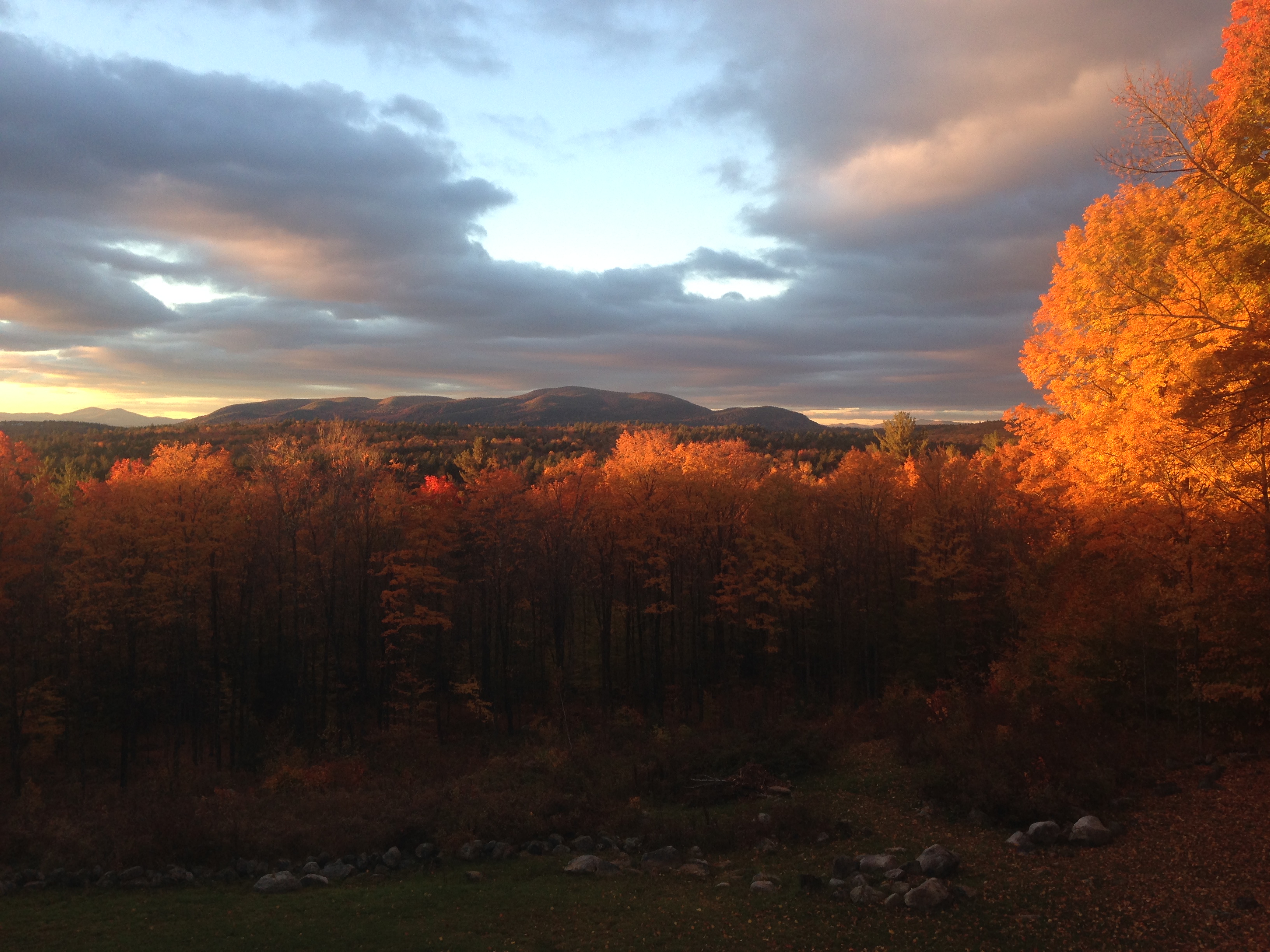
Those of us who live close to the land are graced with many blessings. Moments like the one captured in the photo below are an example – an October sunrise from the ridge where we live.

Many gifts of the earth are essential to our survival – the air we breathe, the water we drink, the food we consume. The aesthetic beauty of the earth expands our hearts; the sense of place grounds our spirits.

A poem by David Wagoner from the anthology Life Prayers offers another grace note of bounty from the earth. Have you ever been turned around in the woods, maybe even lost for a moment? Ever been turned around a bit in your life, having lost your direction? Perhaps you are facing such a time today.

For most of us finding our way (again) begins with being fully present to the moment and its messengers, “to know it and be known.”

Stand still. The trees ahead and the bushes beside you are not lost. Where ever you are is called HERE. And you must treat it as a powerful stranger. Must ask permission to know it and be known.

The forest breathes. Listen. It answers, I have made this place around you. If you leave it, you may come back again, saying, HERE. No two trees are the same to Raven. No two branches are the same to wren.

If what tree or bush does is lost on you, you are surely lost. Stand still. The forest knows where you are. You must let it find you.

October Sunrise on the Ridge (2015) IMG_0306

IMG_7745

Peering from the upstairs window as daylight began to chase the night, I noticed a large deer under the apple tree. It moved slowly, an elegant shadow that ambled unrushed down the hill past the burn pile and out of sight. Later, as the first rays of the sun brushed the tips of the trees, highlighting their fall colors, Thoreau’s familiar passage from Walden came to mind.

We must learn to reawaken and keep ourselves awake, not by mechanical aids, but by an infinite expectation of the dawn…

I know of no more encouraging fact than the unquestionable ability of man to elevate his life by a conscious endeavor…

To affect the quality of the day, that is the highest of arts. Every (one) is tasked to make (their) life, even in its details, worthy of the contemplation of (their) most elevated and critical hour.

Whatever today brings for each of us, whether, like so many in the news we are facing the enormity of loss of home, health or loved ones, or we are just staring at the monotony of routine, we have choices to make. Those choices come from our thoughts, which are the source of our attitude and effort, the brushes with which we paint the quality of the day.

I saw the deer, having just emerged from meditation where I had read the following quote attributed to the Buddha:

The thought manifests as the word; the word manifests as the deed; the deed develops into habit; and habit hardens into character.

So watch the thought and its ways with care and let it spring from love born out of concern for all beings.

What is one thought that will help you affect the quality of your day?

IMG_7745

Autumn returns to our New Hampshire hillside. The light of day grows shorter. Fading from its rare eclipse, the harvest moon wanes. The garden yields its last bounty.

The leaves change color and begin to fall, reprising how much the trees contribute to our landscape and our lives. Throughout the seasons the oxygen they produce fills our lungs with life. Their branches shelter families of birds. A pliant buttress, they buffer us from the strong winds and soothe us with strains of reassurance when the breezes are light. They provide the beams that support our home, firewood that warms our hearths, and grains that inspire and challenge a budding craftsman at the lathe.

In the signature poem of his collection, A Timbered Choir: The Sabbath Poems 1979-1997, Wendell Berry honors these pillars of what to many of us is our spiritual temple. They represent and embrace all of life’s gifts for which the only response can be a grateful heart.

Slowly, slowly, they return to the small woodland let alone: great trees, outspreading and upright, apostles of the living light.

Patient as stars, they build in air tier after tier a timbered choir, stout beams upholding weightless grace of song, a blessing on this place.

They stand in waiting all around, uprisings of their native ground, downcomings of the distant light; they are the advent they await.

Receiving sun and giving shade, their life’s a benefaction made, and is a benediction said over the living and the dead.

In fall their brightened leaves, released, fly down the wind, and we are pleased to walk on radiance, amazed. O light come down to earth, be praised!

Fall 2014 (1)

IMG_7745

Our minds are magnificent liberators. They are also bedeviling oppressors. Much suffering in life is linked to the entrapment of our minds, as we become attached to the pleasurable highs and find the oppressive lows aversive. How can we mitigate the debilitating messages and harness our minds for happiness?

I am working on three strategies. The first is to interrupt the chatter. When the messages seem to be high jacking my thoughts or feelings, I find that a momentary deep breath or a change of activity provides a sufficient time-out to break through the static and allow me to refocus.

The second strategy involves the decision to create a new routine. Research on the brain is finding that a significant percentage of our daily behavior (40%) is habitual. The more the brain can relegate its management of repetitive situations to habit, the more it devotes its energy to paying attention and solving new problems. Two helpful resources for this are Charles Duhigg’s The Power of Habit and Daniel Goleman’s Focus.

For the past several years I have begun each day with a period of yoga, reading and sitting meditation. That routine has helped me diminish old patterns and pay attention to new potential.

The last strategy is the most difficult to do: let go of outcomes. That isn’t to say let go of dreams, setting goals and advocating for our beliefs. It means that despite our best planning, our most committed effort and our most devoted advocacy, results may turn out differently. Rather than bemoan the loss of what we had envisioned, we have the opportunity to open ourselves to possibilities we had never considered.

Taming the mind is both a daily opportunity and challenge. What strategies are working for you?


IMG_7745

For those of us with more years in the rear view mirror than on the road ahead time takes on greater importance as a teacher. The lesson is “there is only now.” It’s a message that younger folks can opt into as well, although it is easier to embrace in our later years.

First, a disclaimer: by “only now” I do not mean living merely for the moment without caring about the impact of our behavior on ourselves and others. That is an indulgent prescription for hurt and harm.

My point is that most of us spend too much time reliving the past, even when part of us knows that it can’t be redone. Or, we fast forward to a fanciful future as an anesthetic for our stress. Much is going on in what we call now. Recognizing it and integrating it can alter not only the instant but the trajectory of the day.

My work with horses has reinforced this. They are fully present, reading and responding to the energy of the moment. Their survival depends on it.

As you read this, what thoughts are surfacing? What do you feel going on inside? Why is that? Paying attention to now may be providing a decision point for transforming your day. If not, whether intentionally or mindlessly, the moment has passed and with it the possibility of insight and a new beginning.

When we are with another person, are we truly present? What message is she communicating? What feelings does he express? What does her sharing surface in us? Are we truly hearing him, or are we focused on fashioning a snappy reply?

When we pay attention, each now opens a new world of possibility.

IMG_7745

When the news of the week drags me down with the dysfunction, vitriol and violence of our species, I search for a framework that provides a meaningful counterbalance. How do we gird our spirits to withstand the tsunami of negativity?

For me it entails shifting a paradigm. Instead of portraying ourselves as the center of the universe as our venerable traditions teach, what if we understand ourselves instead as a precarious experiment in one small laboratory at the margins of the cosmos? It seems like a reasonable possibility, especially as our capacity to love, nurture and create seems to be succumbing to our propensity to vilify, confront and destroy.

Maybe our task in our short span of life is simply to find our calling, pursue it with passion and love those around us. Maybe the energies of love extend out beyond the gravitational pull of our planet to combine elsewhere for the greatest good. Because our perspective is lost in the tall grass around us, we may not know if it makes a difference to anything larger than ourselves and our immediate circles of influence.

Nonetheless, a much larger world beyond our grasp may depend on our persistence in generating love. Mary Oliver raises this prospect in her poem Song of the Builders.

On a summer morning I sat down on a hillside to think about God –

a worthy pastime. Near me, I saw a single cricket; it was moving the grains of the hillside

this way and that way. How great was its energy, how humble its effort. Let us hope

it will always be like this, each of us going on in our inexplicable ways building the universe.

IMG_7745

In his novel, Ishmael, Daniel Quinn describes two cultures of people. Takers think and act on the premise that the world belongs to humans. Leavers behave as if humans belong to the world. Recognizing that you and I are most likely a mixture of the two, on balance which posture dominates your own actions?

The question has particular relevance this week. Unprecedented wild fires continue to burn and drought persists in our country’s west. The president’s trip highlighted Alaskan communities imperiled by melting glaciers, sea ice and permafrost. Anticipating conflicts over access to water, land and food, senior pentagon officials identified climate change as one of our country’s top security threats.

It is easy for us to view our individual footprint on the planet as inconsequential. After all, we are but one individual or family. However, when we add up all the energy that goes into creating and sustaining our ways of living and the effect of producing that energy on the quality of our land and air, the footprint increases considerably.

The planet’s growing population and our propensity to transform the earth’s crust into products of comfort and entertainment for the privileged rather than basic needs for all compound our imprint.

In a two-minute video gone viral Julia Roberts narrates the voice of Mother Earth speaking to humankind. It is a different spin on Ishmael’s takers or leavers. “I have fed species greater than you, and I have starved species greater than you. My oceans, my soil, my flowing streams, my forests…they all can take you or leave you.”

The concluding line is the compelling question for all of us: “I am prepared to evolve…are you?”