Archives for category: Growing Older

IMG_7745

For those of us with more years in the rear view mirror than on the road ahead time takes on greater importance as a teacher. The lesson is “there is only now.” It’s a message that younger folks can opt into as well, although it is easier to embrace in our later years.

First, a disclaimer: by “only now” I do not mean living merely for the moment without caring about the impact of our behavior on ourselves and others. That is an indulgent prescription for hurt and harm.

My point is that most of us spend too much time reliving the past, even when part of us knows that it can’t be redone. Or, we fast forward to a fanciful future as an anesthetic for our stress. Much is going on in what we call now. Recognizing it and integrating it can alter not only the instant but the trajectory of the day.

My work with horses has reinforced this. They are fully present, reading and responding to the energy of the moment. Their survival depends on it.

As you read this, what thoughts are surfacing? What do you feel going on inside? Why is that? Paying attention to now may be providing a decision point for transforming your day. If not, whether intentionally or mindlessly, the moment has passed and with it the possibility of insight and a new beginning.

When we are with another person, are we truly present? What message is she communicating? What feelings does he express? What does her sharing surface in us? Are we truly hearing him, or are we focused on fashioning a snappy reply?

When we pay attention, each now opens a new world of possibility.

IMG_7745

For most of us work dominates our waking hours. It defines who we are and to whom and what we belong. Work is much more than a job that provides a livelihood, although for the fortunate among us the labor that brings out our best and allows us to contribute most to others also supports us.

Work looms especially large in retirement as we face the loss of it. We leave behind decades of identifying ourselves by what we do and others’ recognition of us. Whatever we have professed to this point, the work of living shifts.

The work of living is the key, for our work in this sense does not change. Our most recent job may be ending, but the task of delineating ourselves by the way we create and share meaning does not. There is no stepping down from the occupation of living. In fact, having more time enables us to explore and create new ways to express that unique set of gifts that is our vocation.

In the example of creating poetry David Whyte inspires us to pay attention to the arriving breeze of revelation, the meaning that is our work to discover for each of the days remaining to us.

THE LIGHTEST TOUCH

Good poetry begins with the lightest touch, a breeze arriving from nowhere, a whispered healing arrival, a word in your ear, a settling into things, then like a hand in the dark it arrests your whole body, steeling you for revelation.

In the silence that follows a great line you can feel Lazarus deep inside even the laziest, most deathly afraid part of you, lift up his hands and walk toward the light.


Bob MacArthur

Friendship is one of life’s gifts. Too often in our busy-ness we may forget how important our friends are to us. May this post ring like a bell of mindfulness.

Friendship moves to the center of my awareness today, as Peggy and I prepare to join a group of companions next week. They are high school classmates and spouses. A couple of us were close as teenagers and have remained so throughout life. Most of us, however, shared the vacillating dramas of those years without much deeper contact and only reconnected at our 50th reunion five years ago. We have been journeying together ever since via phone and gatherings.

Next week we’ll spend three days in conversation, sightseeing, music, and mutual support. There will be laughter, good food and deep sharing. We’ll celebrate each other and fortify ourselves for today’s challenges and those that lie ahead.

The roots of the word companion come from the Latin, com (with) panis (bread). Literally and figuratively companions break bread together. Celebrated in the rituals of most religions and spiritual paths, meal fellowship nurtures both body and soul.

Bernie Taupin’s lyrics together with Elton John’s music capture these truths in their song Friends (1971).

It seems to me a crime that we should age. These fragile times should never slip us by.

A time you never can or shall erase, as friends together watch their childhood fly.

Making friends for all the world to see. Let the people know, you got what you need.

With a friend at hand you will see the light. If your friends are there, then everything’s all right.

Does one of your friends come to mind? Would a phone call, visit or email of gratitude be in order?


IMG_0158

During meditation this week these words from Pema Chodron grabbed me: “Only with equanimity can we see that everything that comes into our circle has come to teach us what we need to know.”

What came to mind for me were images from three intersecting circles. The first circle held searing pictures of racism from videos of killings, protests and violence across our land. They confronted me with how far we have to go to heal the deep wounds of slavery, and they raised many questions. Collectively do we have the will to create equality of opportunity? Can we secure justice in the oligarchy that our democracy has become?

The second circle is an outdoor amphitheater that seats 600 in one of the camps of the youth organization I led for several years. The memory of standing in that arena with a blazing fire at its center to speak or lead songs and cheers restores the hope of engaging young people in social change.

In those years we brought together urban, suburban and international youth to strengthen their understanding and appreciation of difference, tap into their idealism and advance their leadership skills to make a difference. Today many of them are advocates for equality and justice in metropolitan St. Louis, Dayton, Cincinnati and elsewhere.

Within the third circle reside the questions of if and how to engage racism at this stage of life when my white privilege allows me to choose not to. What are my obligations in retirement? Oriah Mountain Dreamer’s words ring with their challenge: “I want to know if you will stand in the centre of the fire with me and not shrink back.”

What is in your circle this week, and what is it here to teach you?

Giving Tree IMG_0191

For her bed time story one night this week our six-year-old grandchild chose The Giving Tree. As is often true the simplicity of a child’s tale taps the complexity of an elder’s painfully acquired perspectives.

First published fifty years ago Shel Sliverstein’s story has been interpreted in a variety of ways from a parable of unconditional love to the “me” generation’s exploitive narcissism. (The boy takes everything – fruit, branches and trunk).

When I asked what she liked about the story, our granddaughter had two answers: the tree kept giving and giving and the boy kept getting older and older until all he wanted was to rest on the stump that remained.

The story offers several questions for our reflection. To what extent do we give? To what extent do we take? How do we receive?

Have we identified what it is that we have to give in life? Do we give freely without expecting anything in return? Do we give “it” all away because that may be safer than risking the request for reciprocity?

Do we take without considering consequences, oblivious that the day will come when there is nothing left to take, or, as those of us who are seniors fear, there is little more to give?

Do we take without appreciation? The boy never thanks the tree, although she takes joy from his childhood play in her branches and his periodic visits through the years.

After every gift the tree provides, the narrator reports: “And the tree was happy.” Was it that she was fulfilling her destiny? Was it her unwavering commitment to relationship? How open are we to receiving such bountiful grace?

IMG_0168

For many of us being busy is a badge of honor. We spend much of our lives doing. We define ourselves by the roles that we perform.

For many decades I have done the same, identifying myself by the function I played – student, athlete, spouse, priest, parent, CEO, coach, grandpa. Life was a to-do list of activities, many of which were linked to what I was taught men were expected to do; as Sam Keen described in his book Fire in the Belly – protect, provide and procreate.

Sometimes I “did” well; at other times, not so well. The defining by “doing” in and of itself is done, whatever impact it may have had for good or ill.

Today, I am shifting my focus from defining myself by living to do, to doing in order to be. No doubt, it is in part a reality check as the days remaining in this life grow fewer. I am choosing more activities that cultivate awareness of the simple beauties and complex dynamics of our journey. Meditating, being physically active, working and walking outdoors, writing and playing music are ways for me to develop awareness and attend more to the energy of the moment.

How do you define yourself? Is it the sum total of your activity and the roles you play? Is it the impact your activity generates on those around you? Is it the container you hold for yourself or others to receive the grace of each moment? Perhaps it is all of the above, a harmony of doing and being. We can be grateful and accountable for the fact that it is ours to choose.

IMG_0158

At our 50th high school reunion almost five years ago, several of us found ourselves at dinner together. Connected that night by the promise in our conversation more than memories of our adolescent past, we agreed to stay in touch. Since then we have had over thirty conference calls and several in-person gatherings.

An email this week from one of our group struck home. At its core was a simple and profound call to action in our attitude. It is particularly poignant for those of us elders facing the passing of peers and the loss of capacities we once took for granted.

My friend is a gentle, strong, persistent, mindful and very caring individual. Her husband has been battling cancer for the past twelve years, and she has been by his side every step of the way. Taking advantage of a positive energy plateau in his treatment cycle, they are right-sizing. Her email describes sorting through and disposing the accumulated stuff of many years. She notes that the most difficult aspect in letting go of “things” is the memories associated with them, and she shares some examples.

And then she says, “I remind myself – love the good that is, not what is lost.”

What a great reminder to each of us personally and professionally: tune our attitude to focus on that which is going well, the beauty around us that awaits only our attention and the love that asks only to be received. It is a matter of mindfulness for the moment rather than what was or might have been.

IMG_0133
Today, January 6th, many people observe Epiphany. Like the holy days of every faith it marks a significant event in the tradition of believers. Captured in the story of wise men following a star to a child in Bethlehem, Epiphany celebrates the revelation of Christianity to people outside its source in Judaism.

Whatever the milestones of age, relationships or religion, anniversaries invite us to pause, affirm, regain perspective and recommit ourselves to the journey.

Many years ago on this day I was ordained to the Christian ministry. I was following my star. As I had anticipated, it led me to accompany others through realms of deepest joy and darkest loss. Subsequently, it took me places I could not imagine at the time — out of parish work into farming in rural Appalachia; adventuring through Outward Bound; teaching in the backcountry and in the classroom; working with children at summer camps and in urban schools through AmeriCorps; leading a nonprofit organization, coaching people through transitions in life and work and supporting those who harness the power of horses to heal.

At this stage of life the star continues to beckon, but now it is leading me to let go of much I once relied upon to define myself. Its arc shines not on past successes or failures but on mindfulness in the moment. Its grace is the offer of an inner peace without fear of either the present or the future. My response is no more and no less a task than to accept, receive and embrace the gift. That is my anniversary commitment.

What star do you follow? What surprises has it revealed? What commitment will you make for the next leg of your journey?

IMG_0934

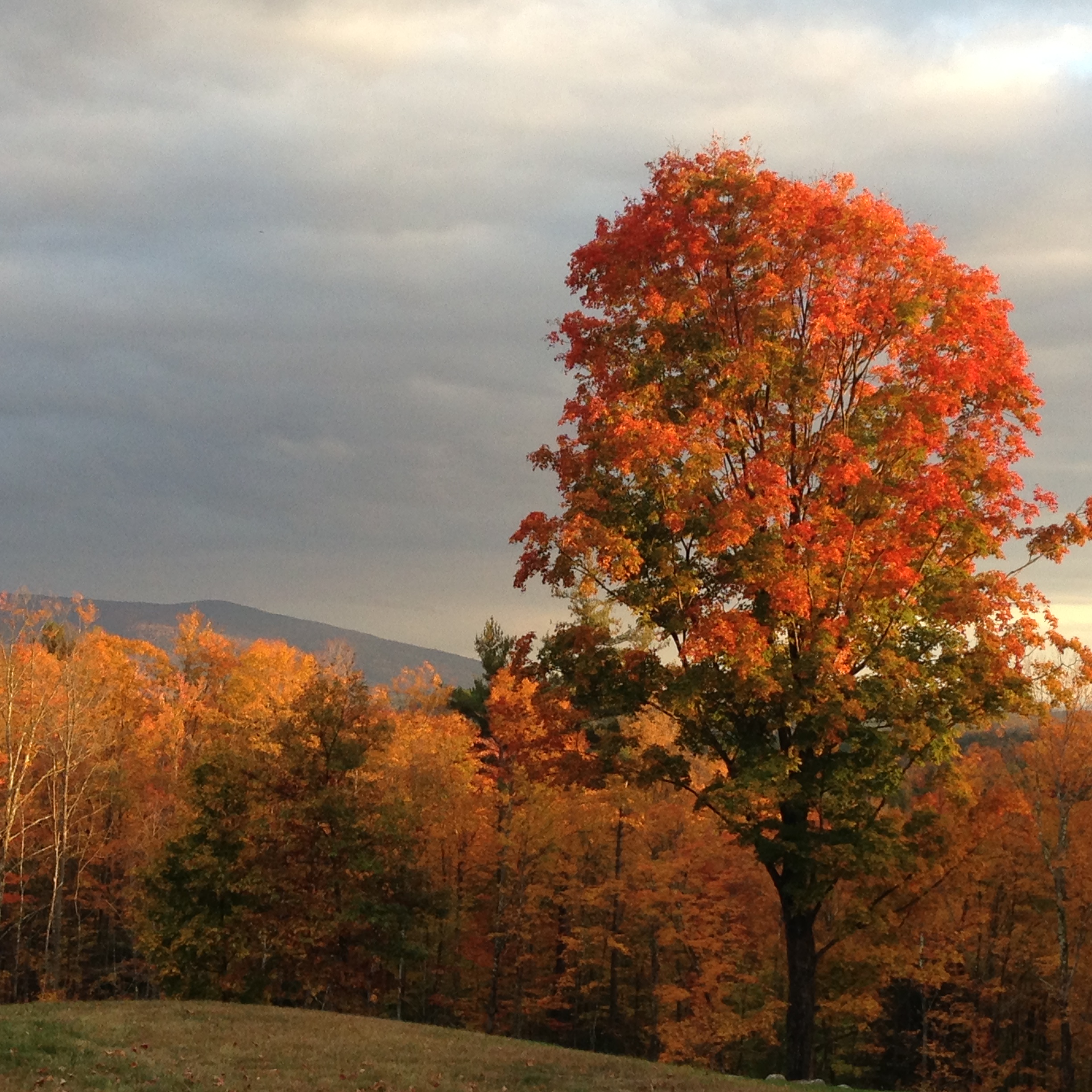
This year’s fall colors have been resplendent, prompting renewed gratitude for my many blessings. The reds, oranges and yellows, punctuated by an occasional green pine exclamation point, also bring to mind the season of this man’s life.

I have just retired from a major piece of my coaching work, and there is more time to devote to the tasks of this decade. Readings from my astrologer and numerologist reinforce that this time of life will focus on introspection and spiritual awakening. It is not that I have been asleep in these matters all my life, but that there will be a new embrace of them and deepening engagement and appreciation.

A meditation reading on my birthday last week provided a succinct summary of this season’s call to action: cultivate loving kindness, do no harm, tame the mind. *  Among the pillars of Buddhist teaching, they resonate profoundly. Going forward, may they be in service not only to this pilgrim but to all who experience their rich colors in the landscape of their own journeys.

* Joan Borysenko, Pocketful of Miracles, October 9th.

Three events last month put me in a time warp: my 50th college reunion, a special gathering of classmates from high school and the deaths of two friends. In contrast to chronological time, which ticks along with steady disinterest even though it appears to speed up with each passing year, the time warp I experienced is kairotic (from the Greek, kairos) – an opportune moment filled with possibility and meaning.

At first glance the relationships from the reunions are anchored in the events of yesteryear and the persons we were at the time. However, the joy I found in reconnecting was not in going back to the past, but rather seeing that the relationships begun decades ago have become a springboard to what lies ahead.

The loss of the two friends with whom I have shared special times was a sad reminder of how quickly chromos ticks along and how important it is for us to seize the auspicious moment NOW. Inevitably, what lies ahead for us physically is decline, but as long as we are able, we have choice about the attitude we bring to the moment. One choice is to nurture those friendships that are grounded in common experiences. By choosing to renew and cultivate those connections, we go back to the future.